The 16 Spanish tenses, explained simply
A plain-English map of every Spanish tense, what each one is for, and how they fit together
Spanish has 16 tenses. That number sounds alarming, and it is the main reason people give up before they start. It shouldn't be. Most of them are built from a handful of parts you already know, and once you can see how the set is organised, learning them stops feeling like memorising 16 unrelated things and starts feeling like learning four patterns and where they point in time.
This guide gives you the whole map in one page: the three time groups, the mood that sits outside time altogether, one example of each tense with the same verb, and an honest word about which ones you actually need first.
On this page
How the 16 are organised
A tense answers two questions at once: when something happens, and how it happens, whether it is a finished event, an ongoing one, or one that was already complete before something else.
Fourteen of the 16 sort themselves neatly by time. Three of them sit in the present, four point at the future, and seven describe the past, which is where Spanish is fussier than English and where most of the real work is. The last two are the subjunctive, and they are not about time at all. More on that below.
Two things are worth noticing on that map before you learn a single ending.
First, the past is crowded. English gets by with far fewer past forms, so a large part of learning Spanish is learning to choose between past tenses that all translate into the same English words. The famous one is Preterite against Imperfect, which has a guide of its own.
Second, several tenses are the same simple idea moved along the timeline. Estar plus an -ando or -iendo form gives you "in progress", and moving estar itself into the present, past or future gives you the Present Progressive, the Past Progressive and the Future Progressive. Haber plus a past participle gives you "already complete", and moving haber along gives you the Present Perfect, the Pluperfect, the Future Perfect and the Conditional Perfect. That is seven of the 16 covered by two patterns.
The present tenses
All the examples below use the same verb, hablar (to speak), so you can see the shape change rather than the vocabulary.
| Tense | Used for | Example |
|---|---|---|
| Present Simple | Habits, routines and general facts. Watch for siempre, todos los días, normalmente. | Hablas español muy bien.You speak Spanish very well. |
| Present Progressive | What is happening right now. In English it always ends in -ing. | Estoy hablando con mi madre por teléfono.I am talking to my mother on the phone. |
| Present Perfect | Past actions with present relevance. In English, have or has plus a past participle. | He hablado con ella esta mañana.I have spoken to her this morning. |
The Present Simple is the one to own first. It is the base that several other tenses are built from, including the Present Subjunctive, and it is what you speak in most of the time.
One regional note worth knowing early: for things finished earlier today, Spain reaches for the Present Perfect (he hablado con ella esta mañana) where much of Latin America would use the Preterite (hablé con ella esta mañana). Neither is wrong. They are two accents of the same language, which is why it is worth deciding early which one you are learning.
The future tenses
| Tense | Used for | Example |
|---|---|---|
| Am Going To | Decided plans and near-future intentions. The decision is already made. | Voy a hablar con ella mañana.I am going to talk to her tomorrow. |
| Future Simple | Predictions and plans. Watch for mañana, el lunes, el año que viene. | Hablaré con ella mañana por la mañana.I will speak to her tomorrow morning. |
| Future Progressive | Something that will be in progress at a particular future moment. | A las ocho estaré hablando con el cliente.At eight I will be speaking with the client. |
| Future Perfect | Something finished before a future point. Watch for para plus a time word. | Para el lunes habré hablado con todos los clientes.By Monday I will have spoken to all the clients. |
The Future Simple has a pleasant surprise in it: the endings are the same for every verb, regular or not, and they attach to the whole infinitive rather than to a stem. Hablar becomes hablaré, comer becomes comeré, vivir becomes viviré. The Conditional works the same way with a different set of endings, so learning one gets you most of the other.
In everyday speech, Am Going To does a great deal of the future work, exactly as "I'm going to" does in English. If you only take two future tenses away from this page, take Am Going To and the Future Simple.
The past tenses
| Tense | Used for | Example |
|---|---|---|
| Preterite | Completed events at a specific moment. Watch for ayer, el lunes, una vez, de repente. | Ella habló con su jefe ayer.She spoke to her boss yesterday. |
| Imperfect | Habits, repeated actions and background description. Watch for siempre, cuando era niño, de pequeño. | De pequeña hablaba sola cuando jugaba.As a child I used to talk to myself when I played. |
| Past Progressive | Something in progress when something else happened. | Estaba hablando con ella cuando llegó el jefe.I was talking to her when the boss arrived. |
| Pluperfect | The earlier of two past events, the past of the past. In English, had plus a past participle. | Ya había hablado con el médico antes de la operación.I had already spoken to the doctor before the operation. |
| Was Going To | Past intentions that did not happen. Often followed by pero. | Iba a hablar con ella, pero se me olvidó.I was going to talk to her, but I forgot. |
| Conditional | Hypothetical situations, things you would do under certain conditions. Usually "would" in English. | Hablaría con ella, pero no tengo su número.I would talk to her, but I do not have her number. |
| Conditional Perfect | Hypothetical past actions that did not happen. In English, would have plus a past participle. | Habría hablado con él, pero no me lo dijiste.I would have spoken to him, but you did not tell me. |
The Conditional sits in this group because of what it is built from rather than when it happens. It describes something unreal rather than something past, and it pairs constantly with the Past Subjunctive: si tuviera tiempo, hablaría con ella, if I had time, I would talk to her.
The subjunctive: not a time at all
Here is the idea that unlocks it, and it is worth reading twice. The subjunctive is not about when something happens. It is about whether it is real, or whether one person is trying to get another person to act.
That is why it turns up after wishes, recommendations, doubts, emotions, and after time or condition words when the event has not happened yet:
| Tense | Triggered by | Example |
|---|---|---|
| Present Subjunctive | A wish, suggestion, doubt or emotion in the present. | Quiero que estudies.I want you to study. |
| Past Subjunctive | The same triggers, once the wishing or doubting itself is in the past. Also the "if" half of a hypothetical. | Quería que estudiaras.I wanted you to study. |
Two rules carry most of it. Only the second verb, the one after que, goes into the subjunctive; the trigger phrase in front stays in its normal tense. And there are normally two different people involved: the one doing the wanting, and the one being wanted to act. I want you to study.
There is one deliberate trap to know about. Verbs of thinking and believing work the opposite way round from verbs of wanting. Creo que and pienso que take the ordinary present, because you are stating something you hold to be true. Negate them, and doubt creeps in, and with it the subjunctive: no creo que tenga razón, I don't think he's right.
Where commands fit
Commands are worth a mention here because they are so often miscounted as a tense. They aren't one. Commands are a mood, like the subjunctive, and they are closely related to it: every negative command, and every usted, nosotros and ustedes command, uses Present Subjunctive forms.
¡Habla más despacio! is a positive tú command, speak more slowly. ¡No hables tan rápido! is the negative, don't speak so fast, and there is the subjunctive doing its second job. There is no yo command, for the obvious reason that you do not order yourself about, and no ellos command either.
What actually makes tenses hard
It is worth being straight about this, because it changes how you should practise.
The endings are the easy part. They are regular, they repeat, and a week of attention gets you most of the way. What takes longer is choosing: standing in a real conversation, wanting to say something about last summer, and having to pick between the Preterite and the Imperfect before the sentence comes out. That choice is not a memory problem, it is a judgement you build by seeing the same pair contrasted again and again in real sentences.
The second thing that catches people is that Spanish and English do not line up one to one. "I have spoken" and he hablado look like the same tense, and usually are, until you cross from Spain to Latin America and the habit shifts. "I was talking" could be the Past Progressive or the Imperfect depending on what the sentence is doing. Learning a tense as an English label attached to a Spanish ending will get you to a certain level and then quietly stop working.
How nemiria teaches this
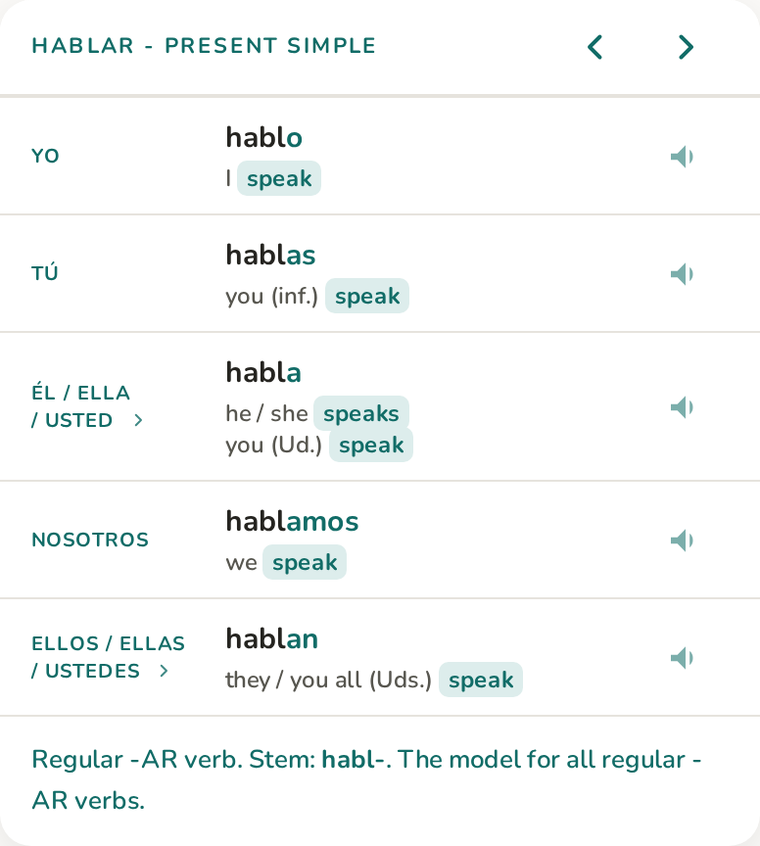
This is the thinking behind the app. Every tense is laid out as a full table for the verb you are looking at, with the English written under each form rather than off in a separate list, so the contrast between the two languages is visible in the same glance. Each form has a speaker button, because the shape of a tense is easier to recognise in the ear than on the page.
There is also a Compare tenses view that puts related tenses next to each other with the same five sentences, which is the fastest way to stop guessing between two past tenses that translate into the same English.
Where to start
If the 16 still feel like a wall, here is an order that works, and it is roughly the order the app presents them in.
- Present Simple first, until it is automatic. Other tenses are built on it, including the whole subjunctive.
- Then one past and one future, so you can tell a story and make a plan: the Preterite, and Am Going To.
- Then the Imperfect, specifically against the Preterite, not on its own. The choosing is the skill.
- Then the two "machine" patterns: estar plus -ando or -iendo, and haber plus a past participle. Those two unlock seven tenses between them.
- The subjunctive last, and not because it is hardest. It is because it makes far more sense once you already have the tenses it borrows its forms from.
Sixteen tenses is a fact about Spanish, not a warning. Nobody learns them in a fortnight, and nobody needs all 16 to hold a conversation. Learn the ones that let you say what you actually want to say, in the order above, and the rest fill themselves in.
Read next
nemiria is a calm Spanish verb trainer for iPhone and iPad: all 16 tenses, 16 verb groups, Spain and Latin America side by side, with practice that asks you to build and type the forms rather than only recognise them. Get it on the App Store.