Why "I like coffee" is back to front in Spanish
What me gusta el café actually says, and why gustar stops being an exception once you see it
Me gusta el café does not say "I like the coffee" in the way English says it. Word for word, the coffee is doing something to you. The coffee is the subject of the sentence, and you are on the receiving end.
That one flip explains everything that looks strange about gustar: why the verb usually has only two forms, why the person never changes it, and why so many learners produce yo gusto el café for years without being corrected.
The sentence everyone learns wrong first
Nearly every Spanish course teaches me gusta el café in the first few lessons, and nearly every learner files it away as "me gusta = I like". That works perfectly until the day you want to say you like the books, and out comes me gusta los libros, and a native speaker gently says me gustan.
The reason is that the sentence is not built the way it looks. Here is the same sentence with its parts labelled.
| Part | Word | Job in the sentence |
|---|---|---|
| Object | me | The person affected. Not the one doing anything. |
| Verb | gusta | Third person singular, because it agrees with the coffee. |
| Subject | el café | The thing doing the pleasing. |
So the Spanish sentence is closer to "the coffee pleases me". English turns the whole thing round and makes the person the subject: "I like the coffee." Both sentences mean the same thing. They are built in opposite directions.
Once you see that, the plural stops being a rule to memorise and becomes obvious. Me gustan los libros has a plural subject, the books, so the verb is plural. It was never about you.
Why there are usually only two forms
This is the practical payoff, and it makes gustar easier than an ordinary verb rather than harder. Because the subject is the thing being liked, and things are either one or more than one, you mostly need only two forms of the verb in any tense:
| Subject | Spanish | English |
|---|---|---|
| One thing | Me gusta el café. | I like the coffee. |
| More than one | Me gustan los libros. | I like the books. |
What changes to say who is doing the liking is not the verb but the little pronoun in front of it: me, te, le, nos, les. The verb sits there unmoved.
Me gusta el café (I do), te gusta el café (you do), nos gusta el café (we do). Five different people, one unchanged verb. Compare that with the five endings you have to produce for an ordinary verb and gustar starts to look like a gift.
There is one situation where the verb does move, and it follows from the same rule. If the thing being liked is a person, the verb agrees with that person: me gustas means "I like you", with you as the subject doing the pleasing. It is worth knowing about so it doesn't ambush you, and it is worth being aware that in the singular it lands somewhere between "I like you" and something warmer.
It isn't one odd verb, it's a family
Gustar gets taught as an exception, which is unfortunate, because it is a member of a decent-sized group. Spanish grammarians call them verbos de afección, verbs of affection or feeling, and the Real Academia's grammar lists a long run of them, including doler, encantar, interesar, molestar, preocupar and sorprender, all built the same way, with the person as an indirect object and the thing as the subject.
So the work you put into understanding gustar is not spent on a single verb. It buys you:
- Me encanta el café. I love the coffee. The coffee does the enchanting.
- Me duele la cabeza. My head hurts. The head does the hurting, which is why Spanish does not need "my".
- Me interesan los idiomas. Languages interest me, and English happens to agree with Spanish on this one.
That last example is the useful one to hold on to. English does have this pattern. "Languages interest me", "that surprises me", "my head hurts". It just doesn't use it for liking. Spanish is not doing anything exotic here; it is applying a structure you already own to a verb where English chose the other option.
How to teach a sentence that runs backwards
Here is where it gets interesting, and it is the part we had to make a decision about when building nemiria.
There is an old and genuinely good technique for showing a learner how a foreign sentence is put together: print a literal, word-for-word translation next to the natural one. In linguistics this is an interlinear gloss, standardised as the Leipzig Glossing Rules. In language teaching it goes back at least to James Hamilton (1769 to 1829), whose interlinear editions of Latin texts were popular enough to be called the Hamiltonian system, and it survives in modern courses: Assimil, for instance, presents a translation that also shows how each sentence is constructed.
Applied here, the literal gloss is lovely. Under me gusta el café you write "it pleases me", and the machinery is suddenly visible.
The trouble is that it does not scale, and the reason is tenses. Spanish has 16 of them. Write the literal gloss for each and you get a new English phrase every time:
- me gusta becomes "it pleases me"
- me gustaba becomes "it was pleasing me"
- me va a gustar becomes "it is going to please me"
- me habría gustado becomes "it would have pleased me"
Every one of those is a separate English sentence that somebody has to write, check and keep in step with the Spanish. Sixteen chances to introduce a mistake, per verb. And the wording gets stranger the further you go, so the technique is at its clumsiest exactly where learners need it most.
So the app does something slightly different. Rather than printing a literal translation, it names the flip once:
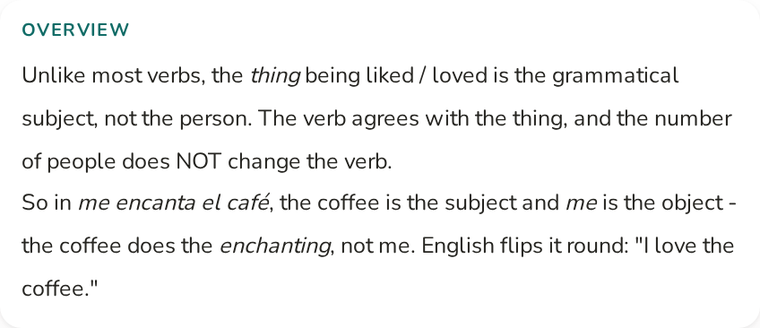
The comment sitting next to that line in the app's source says exactly why it is worded that way: phrased as the subject and object flip rather than as a literal translation, so that it stays true in every tense without needing a third-person English verb phrase written out sixteen times.
One structural fact, stated once, does the same teaching job as 16 literal glosses and cannot drift out of step with the Spanish. The learner still gets the machinery, without the app promising sixteen small hostages to fortune.
The bug that made the point
An earlier build of nemiria got this wrong in an instructive way. The explanation card showed the Spanish in whichever tense you were studying, but the English underneath was fixed in the present. So the card could read me va a encantar el café with "I love the coffee" beneath it: correct in exactly one of the 16 tenses and wrong in the other 15.
It is an easy mistake to make and a hard one to notice, because each half looks right on its own. An app that teaches by contrasting two languages has to get the contrast right in every tense, or it is teaching the wrong contrast with great confidence. The fix was to hold the English per tense, alongside the Spanish, so the two can never drift apart again.
What to do with all this as a learner
Three things, in order.
Say the flip out loud when you practise. "The coffee does the pleasing." It feels silly for about a day, and then it sticks, and me gustan los libros stops needing a rule.
Drill the two forms, not five. For gustar, encantar and the rest of the family, the singular and plural of the third person cover nearly everything you will say. Put your effort into the pronoun instead, which is the part that carries the meaning.
Watch for it in the tenses you already know. Me gustó la película (I liked the film), me gustaba el colegio (I used to like school), me encantaría (I would love to). The flip holds in all of them, which is the whole reason it is worth learning as a structure rather than as a phrase.
Read next
nemiria drills gustar and encantar as their own verb group, in every tense, with the explanation above attached to whichever tense you are practising. Get it on the App Store.